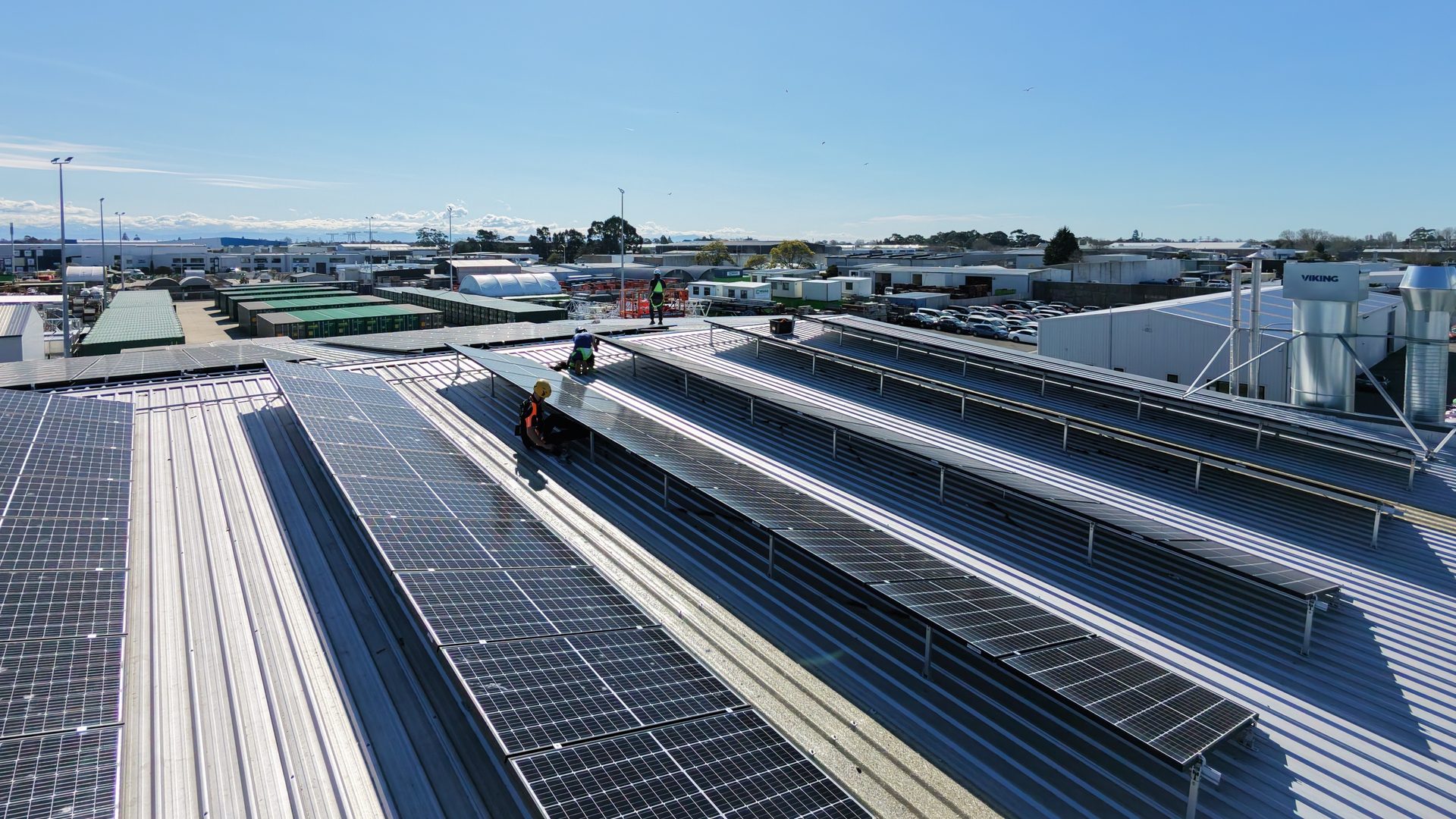
Irrigation runs through the day. Milking is dawn and dusk. Vat refrigeration and cool stores run flat out through summer, which is exactly when an array generates most. A farm that consumes its own generation on site is not relying on a buy-back rate to make the numbers work, and that is what separates a good solar case from a marginal one.
Solar
Where the array goes on a rural property
A farm rarely has one obvious roof. It has several, plus land, so the design question is which surface, at what angle, and how far it sits from the load.
Shed & barn roofs
Implement sheds, woolsheds and dairy sheds are usually the cheapest square metres on the property: large, unshaded, already structurally sound and close to a three-phase supply. We check the purlins and the roof's remaining life before we commit to it.
Ground-mount arrays
Where the roofs are wrong: too small, too shaded, too old, or facing the wrong way, a ground-mounted array on a corner of unproductive land is often the better answer. Fixed at the optimal pitch for the latitude, fenced from stock, and sited to keep the cable run short.
Storage & off-grid
Batteries earn their keep on a farm twice over: shifting daytime generation to the milking shed at 5am, and keeping the essentials alive when a rural line goes down in a storm. For a remote block or a back paddock, a standalone off-grid system can beat the cost of running a new line.
We were a registered electrical contractor long before we were a solar company, which is why we can take on the switchboard, the pump shed and the array as one job rather than three trades and three invoices.
Pump starters, soft starters and variable-speed drives, three-phase control gear, protection and isolation. Fault-finding when a pivot stops mid-season, and the sort of preventative work that stops it happening in February.
Plant wiring, vat and refrigeration circuits, wash-down and hot water, shed lighting, and the earthing and RCD protection a wet environment full of stock and staff has to have. We work around milking rather than through it.
Rural boards are often decades of additions on top of an original that was never sized for today's plant. We upgrade, certify and document, and we handle the application with your lines company: Orion or MainPower, including any capacity or export limits.
Generator connection and changeover switching done properly, so a cow shed and a chiller keep running through an outage without back-feeding the network. A battery can cover part of this too. We will tell you honestly which is the better spend on your property.
LED upgrades across sheds and yards, which on a property running lights through two dark milkings a day is one of the fastest paybacks available. Plus sensor and security lighting on tracks, gateways and building perimeters.
The electrical side of horticultural plant: frost fan supply and controls, cool store and packhouse refrigeration circuits, and the monitoring that tells you something has tripped before the crop finds out.
Pump and stirrer circuits, level controls and alarms on effluent and water systems, wired so a failure raises an alarm rather than a compliance problem.
We are Approved Starlink Installers in New Zealand. Dish mounted properly, cabling run neatly, and the network side actually working, including getting a signal from the house out to the shed and the office, which is usually the real problem.
We have done this on homes, rural businesses and a marae, with the internal networking to go with it.
Full wiring on new farm buildings, implement sheds and workshops, planned with your builder and staged to the programme, including three-phase outlets, welding supply and getting the conduit in before the concrete goes down.
Scheduled maintenance across a property's plant, thermal and visual checks on boards, testing and certification, and being reachable when something stops working at an inconvenient hour.
Why rural clients choose us
One team for the arrayand the switchboard
Most solar companies sell the panels and subcontract the electrical work. On a farm that is a real problem, because the interesting part of the job is never the panels. It is the three-phase board, the pump circuits and the grid connection.
Master Electricians and SEANZ members: solar and electrical from one accountable team
Three-phase experience: irrigation, dairy plant and cool stores, not just houses
SiteWise certified, so we are already prequalified for the sites that ask
We handle the grid-connection application and export limits with Orion or MainPower
Family-owned and local. We know the roads, the roofs and the lines companies
Usually, but it is the first thing we check rather than the last. We look at the purlin spacing, the fixings and the roof's remaining life, because if the roof needs replacing in five years, mounting an array on it now is a false economy. If the roof is not right, a ground-mount is.
It will offset a share of it, and on a lot of Canterbury properties that share is significant, because irrigation runs in daylight. Whether it covers the whole load depends on the pump size, the hours and how much roof or land you can commit, which is exactly what the assessment is for. We will show you the numbers rather than a percentage from a brochure.
The opposite. It is an advantage, and it is where our electrical background earns its keep. Three-phase inverters are well supported, and a farm's larger loads are usually three-phase already. We install three-phase systems as a matter of course.
Yes, and that is the point of calling us rather than a solar-only company. Switchboards, pump control, shed wiring, generator changeover, lighting and Starlink are all our own work, on the same job and the same invoice.
If the property is your home, a lifestyle block for instance, the bank green home loans on our residential solar page apply, several at 1% or interest-free. For a working farm it is more often asset finance, a lease or capital, and there may be depreciation to consider. We are not financial advisers; we will give you the itemised quote your bank or accountant needs.
Yes. We work throughout Canterbury, from Kaikōura down to Timaru and inland to the foothills. The full list of localities is in the footer of every page. If you are not sure whether you are in range, call and ask.
Want the numbers for your property?
Book a farm walk-through and we will tell you honestly what stacks up and what does not.